Plasmata
Every module so far asks what a rule — written, trained, or selected — can produce on a lattice. Plasmata is a sibling project asking the same question of a different substrate: continuous, physically modeled solar plasma rather than any rule chosen in advance. This page hosts prose about that project alongside this project’s own from-scratch toy physics engine, tested to the same standard as everything else in this atlas.
part of The Automata Atlas →
Plasmata — the sibling question, asked of matter
Plasmata is a solar-plasma laboratory searching, in the site's own words, for "life-like dynamics in a solar plasma." Its physics is 2.5D isothermal resistive MHD — the coronal-loop geometry the sun's own magnetic loops sit in — evolved forward in Elsässer carriers W⁺ and W⁻ plus a current J, all starting from zero: no seed structure, no hand-placed pattern, just the field equations and time.
This atlas has spent nine phases asking what a rule — written, trained, or selected for — can produce on a lattice: gliders, replicators, structured equilibria, a rule that learns its own numbers. Plasmata asks the same question of a different substrate: not a rule anyone chose, but continuous, physically grounded matter, to see what it organizes into on its own.
Plasmata runs six "emergence starters," arenas built to test for a specific kind of self-organization rather than to reproduce a known result: a homogeneous coronal loop (wave-supported magnetic organization), a fluctuation bath (spontaneous individuation), a fissioner alpha (repeated body splitting), a metastable propagule (compositional inheritance), a loop challenge (boundary maintenance), and a field filament (transport-guided organization). Four further "positive controls" — an Alfvén packet glider, a zero-net dipole glider, a flux-rope breather, and a counter-packet collision — are deliberately excluded from any emergence claim: they exist to prove the instrument can detect known, designed structure at all, not to demonstrate anything novel.
All of this runs in a persistent experiment rack rather than as one-off trials: matched A/B arms share a starting state, with arm B given an independent forcing seed, run alongside footpoint-drive-off, phase-scrambled-drive, and high-damping control variants. A candidate is watched continuously against its own controls, not examined once and called a result.
The next two sections cover how Plasmata judges what it's watching (heredity, the falsification standard); the last two are this project's own contribution — a from-scratch physics engine and a toy demonstration of that same falsification logic.
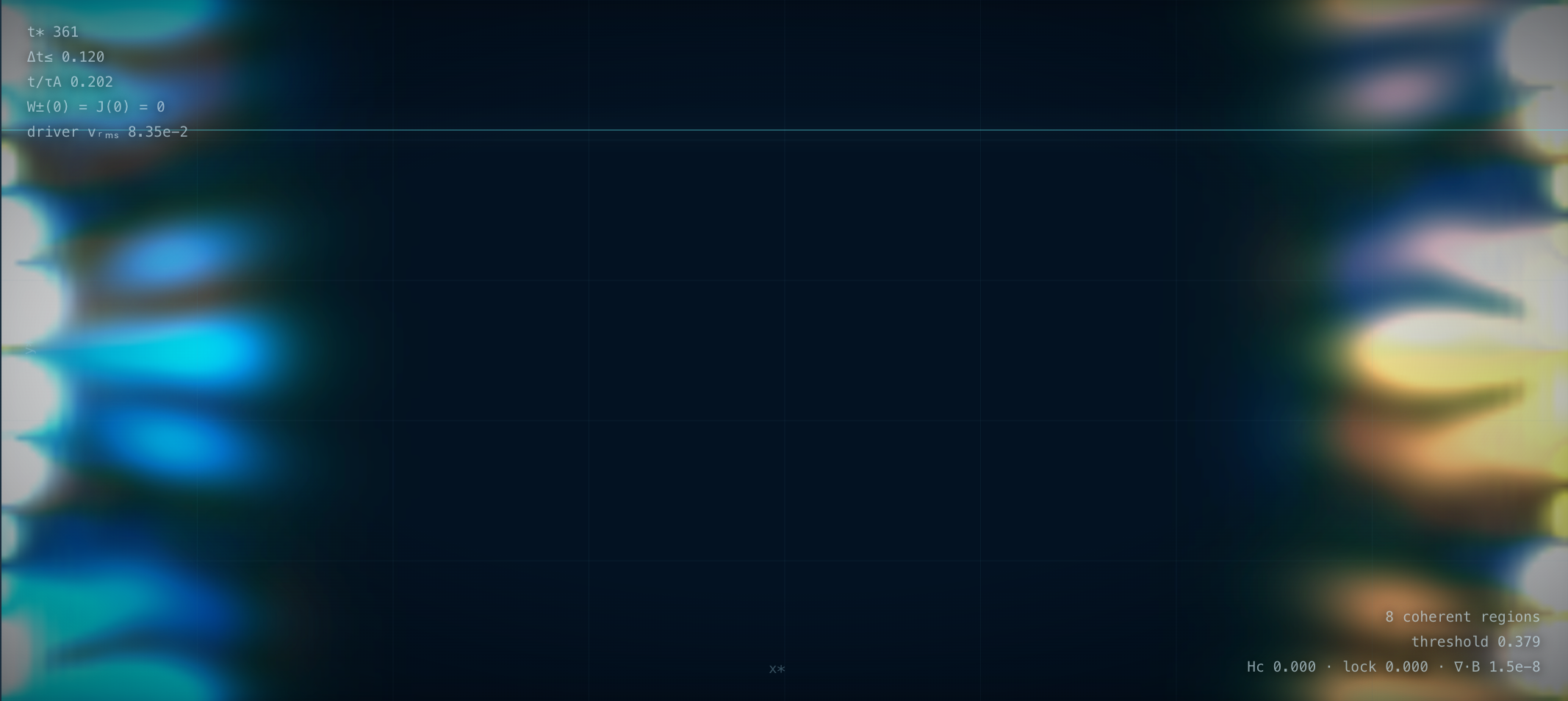
Plasmata's own interactive plasma field, mid-run: both footpoints driven and glowing at the boundary edges, the interior dark with no persistent structure of its own — the site's own HUD (8 coherent regions, threshold 0.379, coherence Hc 0.000, lock 0.000) is the site's own reading, not this project's.
Captured from the live Plasmata site, 2026-08-19.
Heredity — a destination, not yet a result
Plasmata's long-term target is what its site calls hereditary plasma attractors: self-organized structures the physics produces and then, in principle, propagates — a parent structure ablated, a descendant surviving that ablation as genuine transmission rather than coincidence. The site's own promotion ladder runs upward from Tier 0, and no candidate has been promoted past it: the site states the reason directly, "Tier is capped below reproduction until parent-ablation and multi-generation transmission tests exist." A "lineage trace" panel exists for exactly this purpose — labeled for provisional descent state-change candidates — but as of this writing it is still waiting for its first entry, showing a candidate score of 0.000 and zero coherent regions. Heredity is Plasmata's stated destination, not a demonstrated result.
Whether any candidate is even a coherent structure worth tracking is decided by named metrics, not by eye: an Alfvén crossing time (τ_A) serves as the site's own natural time unit; a segmentation threshold separates a coherent region from background noise; a coherent-region count tracks how many such regions exist at once; translation-shape R² checks whether a moving structure keeps its own shape; spectral entropy tracks how concentrated or diffuse its Fourier content is; and a post-cut energy ratio is exactly the falsification move the next section describes, applied to a real candidate instead of a toy.
This atlas already has its own replicators — Langton's loop, which copies a fixed 8-state pattern exactly, every time, with no variation for selection to act on; and the evolution loop, which selects Lenia genomes for persistence plus novelty across a handful of generations, over a hand-specified two-parameter genome space. Neither is what Plasmata is after. Plasmata's hereditary attractors, if and when parent-ablation and multi-generation transmission tests exist to certify them, would be a lineage that emerged from physics itself, not from a rule table or a parameter space this project chose in advance — a different, harder question, not a fancier version of either loop.
The falsification battery — a rigor standard, shared
Plasmata states its promotion standard as a method, not an impression: "Driver independence, cutoff survival and numerical convergence — not visual complexity — govern promotion." A candidate fails if, in the site's own words, it is "locked to the footpoint driver, disappears under grid refinement, or fails matched no-drive and phase-scrambled controls." Three separate ways to fail, each aimed at a different illusion: a pattern that only exists because something outside it keeps feeding it energy, a pattern that only exists at one particular grid resolution and vanishes at a finer one, and a pattern that a matched control — the same setup with the drive off, or with its phases scrambled — would have produced anyway. The positive controls named in the program section are excluded from any emergence claim for the same reason: proving the instrument can detect a designed structure isn't evidence that an undesigned one is real.
That standard is this project's own, run on a different substrate. Every claim in this atlas is scoped to what an actual test asserts, with the bound and the measured endpoint both named rather than a vague impression of "it works"; every widget is a display snapshot of a tested engine, not a standalone animation; and the About page keeps a running account of exactly what's measured, what's schematic, and what's still an open question. Plasmata's driver-independence and phase-scrambled controls are the same falsification instinct this project applies to its own claims: before a result counts, cut whatever might be secretly doing the work and see whether the result survives losing it. Two sections from here, that exact move — cut the drive, scramble the phases — runs live on two toy signals, so the logic is something to watch rather than just read about.

live chamber

footpoint drive off

phase-scrambled drive
high damping
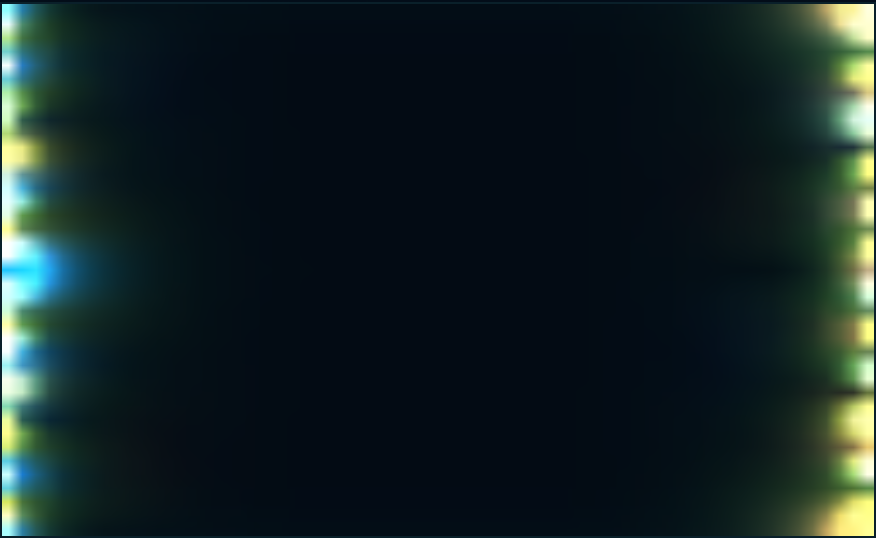
The battery, in pictures: Plasmata's live chamber beside its own no-drive, phase-scrambled, and high-damping controls. The no-drive chamber is nearly dark — as of this capture, nothing in it self-sustains without the driver, which is the control's whole point.
Captured from the live Plasmata site, 2026-08-19.
Alfvén waves — this project's own toy physics
This project's own Alfvén-wave engine (packages/engine/src/alfven.ts)
is the toy physics behind the Plasmata instrument on this page: two
counter-propagating Elsässer fields, z⁺ and z⁻, on a periodic 1D line,
each a pure spectral phase rotation at speed ±v_A with no interaction
between them in this ideal, 1D, constant-v_A case — a decoupling that is
exactly why a z⁺ packet and a z⁻ packet pass through each other
unchanged.
That pass-through is Plasmata's own "counter-packet collision" positive control, in miniature: on the real site, colliding wave packets test whether an interaction leaves behind a persistent localized remnant; here, the same collision is exact enough to test directly, to floating-point precision. Every step is a spectral rotation, not a finite-difference approximation, so there is no discretization error at all — only rounding, which is why the claims below are tested to 1e-9.
Four facts this project's test suite checks, each to a stated bound: a launched packet's centroid moves at v_A to within 1e-9 after 100 steps; two packets launched toward each other cross, and the full two-packet run over 300 steps matches a single composed 300·dt step of that same state to within 1e-9 per cell; a single Fourier mode's amplitude decays at exactly exp(−ηω²t) over 200 steps, within 1e-9 relative error; and, at zero damping, total energy drifts by less than a relative 1e-9 over 500 steps. Every one of these bounds is scoped below the grid's Nyquist wavelength, per the engine's own documentation — a smooth packet built at the widths this widget launches carries negligible energy at that limit, so the exactness holds for everything actually on screen.
Launch a z⁺ and a z⁻ packet toward each other above and watch them cross without disturbing one another — the same counter-packet test Plasmata's own chambers run, at a scale small enough to check exactly.
The battery, run on two toy signals
This exhibit (packages/engine/src/battery.ts) demonstrates the LOGIC of
Plasmata's falsification battery on two toy candidates only — it makes
no claim about, and does not reproduce, any actual candidate from
Plasmata's own chambers. driven is a standing pattern sustained by
continuously forcing one grid cell at a fixed frequency, damped the
whole time by the same resistivity the Alfvén section above uses — left
alone, that damping would erase the pattern, so the driver is the only
thing keeping it alive. packet is the same ideal (undamped) Alfvén
packet from the section above, launched once and otherwise left alone,
never forced by anything after that first launch.
Cut the drive and the difference is immediate and measured, not just visual: 300 steps after the cut, the driven candidate's energy ratio falls to 0.396 (seed 1) — the driver-locked pattern's tell — while the self-propagating packet's ratio stays at 1.000, unaffected by losing a driver it never depended on. Phase-scrambling the packet is the other control: it preserves the packet's total energy to within a relative 1e-9 while its coherence — a peak-to-RMS measure of how sharply localized it still is — collapses to 0.474 of its pre-scramble value. Same energy, destroyed shape: exactly the distinction a driver-locked pattern and a self-propagating one make visible under the same two cuts.
The energy-ratio readout under each candidate above is the same post-cut energy ratio named among Plasmata's own metrics in the heredity section — just measured here on a forced cell and a launched packet instead of an actual coronal-loop or fluctuation-bath candidate. These two toy signals are not what Plasmata is testing for real. Its own persistent rack runs six chambers continuously against matched no-drive, phase-scrambled, and high-damping controls, on actual coronal-loop and fluctuation-bath physics rather than a single forced cell and a launched packet — see the live site for those.
Experiments
This project ran its own experiments in the same spirit as Plasmata’s: a reduced 1D plasma equation, searched by relaxation rather than solved in closed form, screened across seed space, and — in one case — a learned rule that missed its own gate. Four sections follow, one of them a negative result reported as exactly that.
The DNLS breather — found, not written
DNLS, the derivative nonlinear Schrödinger equation, is the reduced 1D model for finite-amplitude Alfvén waves propagating parallel to the magnetic field in Hall-MHD (Mjølhus, "On the modulational instability of hydromagnetic waves parallel to the magnetic field," J. Plasma Phys. 16(3), 321–334, 1976): one equation, b_t = i·b_xx − (|b|²b)_x. The structure below was not copied from a closed-form solution: this project's own search relaxed a circularly polarized, sech-shaped seed forward in time and watched what it became — linearly polarized seeds, tried first, simply shed, a documented negative that narrowed the search to circular polarization and negative wavenumbers.
What relaxation produced is not a fixed-shape soliton but a traveling breather: its width oscillates between 4.78 and 19.87 — a 4.2× swing — on a period of roughly 144 time units (72,000 steps), matching itself most closely once per period: local correlation 0.9996, comparing the settled profile to itself a full period later.
Strip the amplitude away and the profile falls apart. Launched at 0.1× amplitude, the identical shape doesn't breathe — it disperses. At the same +12,000-step offset where the full-amplitude specimen's width contracts from 11.61 to 6.32 (a breathing-cycle phase), the 0.1× copy's width grows to 22.23. That time-matched contrast — not a bare width factor, which the breather's own swing up to 19.87 could otherwise mimic — is what separates a soliton sustained by its own nonlinearity from a packet coasting toward dispersal.
Three more checks back the same result: scrambling the field's Fourier phases preserves total energy to within a relative 8.79e-15 (bound 1e-9) while collapsing the peak to 0.356 of its original (bound 0.6); doubling the grid resolution and halving the time step reproduces the same peak and width at matched physical time to within a relative 1.13e-4 and 4.9e-6 (bound 1e-3, both); and total energy drifts by only 8.02e-10 relative over 30,000 steps (bound 1e-8).
A reduced 1D equation, not coronal plasma, not one of Plasmata's own chambers — a toy engine held to this atlas's tested-claim standard. It joins persistent structures found under other rules: Life's traveling gliders, this atlas's own Lenia creature holding its position instead, a 1D neural CA that heals a wound rather than moving. A DNLS breather travels and breathes, sustained by amplitude rather than written into a rule — a different substrate, the same question of what keeps a structure whole.
The glider lab — travel, breathe, collide
This project's own instrument (packages/engine/src/dnls.ts,
packages/engine/test/collision.test.ts) renders the specimen from the
section above as a moving spacetime ribbon instead of a single static
trace: brightness tracks |b|, the ribbon's slope down the frame is the
glider's speed, and the ribbon's thickness oscillating as it travels is
the breathing — the same ~144-time-unit period measured above, now
something to watch rather than a number to read.
Switch to Collision and the widget opens at t=30,000: two gliders composed from the specimen's own recipe — a fast one (k₀=−1.2) and a slower one (k₀=−0.5) — already well separated, |b|=1.073 and 0.761. Around t≈60,000 their cores merge into a dominant flare — |b|=1.6237 at the t=60,000 sample — alongside a qualifying secondary peak (|b|=0.6068 at that same sample): not a single merged peak, and the peaks readout may briefly show three as a lower-amplitude residual lingers in the debris. By t=90,000 both gliders have re-emerged as two distinct, separately traveling structures: the fast one back near |b|=1.075 at a segment speed of about −1.49, the slow one at |b|=0.920 — still visibly breathing within its own band — at about −0.42. Total energy drifts by only 8.63e-9 relative over the full 90,000-step run: survival, not destruction, is the tested claim, and the vendored snapshot is checked byte-for-byte against a fresh composition before either continues.
DNLS, the same Mjølhus 1976 equation from the section above, is an integrable equation — the theoretical expectation for an integrable system is that solitons pass through a collision and re-emerge unchanged, not merely approximately survive it. This measurement isn't a surprise; it's a direct check of that expectation against this project's own engine, not a paper's derivation.
A reduced 1D equation on a toy engine, not coronal plasma and not one of Plasmata's own chambers — held to the same tested-claim standard as the rest of this page.
The hunt — a bestiary swept from seed space
This project's own screening sweep (packages/engine/src/dnlsHunt.ts,
packages/engine/data/gliderHunt.json) ran 96 circular-sech seed
configurations — 4 amplitudes × 8 carrier wavenumbers (k₀) × 3 widths —
through a shared classifier: 30,000 transient steps, then a 12,000-step
measurement window checking each seed's shape correlation and speed
(speed is a single circular displacement across that window, so configs
faster than about 2.08 units per time unit wrap the periodic box and
record a folded value — classification only checks whether |speed|
clears 0.1, which this wrap never crosses, but the speed number itself
understates how fast the fastest seeds actually travel).
That window matters, and it caps what this sweep can claim. The specimen in the section above turned out to be a breather with a period around 72,000 steps — six times longer than this sweep's measurement window. A genuinely persistent seed sampled mid-cycle can screen as marginal or even shed. This sweep is a cheap screen across many configurations, not the full falsification battery only the specimen itself has been run through; every count below is screening-grade, not verified-grade.
Of the 96 seeds screened, 25 screened as glider, 39 as marginal, and 32 as shed.
each dot is one DNLS seed swept across amplitude (A), k₀, and width (three widths share each amplitude/k₀ cell, offset slightly for legibility — the offset is a layout choice, not a data value); dot size scales with the seed’s measured speed. Of 96 DNLS seeds screened across amplitude, k₀, and width, 25 screened as glider, 39 as marginal, and 32 as shed; negative k₀ screens as glider far more often than positive k₀ (25 of 48 vs 0 of 48). This is a screen over a 12,000-step measurement window, not a falsification-battery verdict — only DNLS_SPECIMEN_SEED has been run through that full battery (settlement, persistence, dispersal, scramble, refinement, long-run); a genuinely persistent breathing config sampled mid-cycle can screen as marginal or shed. Speeds beyond ±2.08 fold when they wrap the periodic box within the measurement window — dot sizes for the outer k₀ columns understate true speed, though classification (which only checks whether |speed| clears 0.1) is unaffected.
The clearest single fact in the bestiary is a complete split: 25 of the 48 negative-k₀ seeds screen as glider, and 0 of the 48 positive-k₀ seeds do — not one exception anywhere in the sweep. Which way the carrier wave's phase winds decides more than amplitude or width does.
That asymmetry has a nuance worth stating plainly: at the two highest amplitudes swept (A ≥ 1.1), 19 of 24 negative-k₀ rows are not glider (16 marginal, 3 outright shed) — only 5 of 24 classify glider at high amplitude. Negative polarization is necessary across this whole sweep, but a strong seed is more likely to shed than a modest one; the asymmetry is a fact about direction, not a guarantee that raising the amplitude keeps a glider intact.
The same negative result that shaped this search shows up here too: earlier rounds tried linearly polarized gaussian pulses instead of circularly polarized sech envelopes, and those shed without ever being captured by anything — part of why this sweep tests circular polarization only, across the amplitude/k₀/width grid above, rather than a broader family of pulse shapes.
The learned rule that didn't make the gate
This project's own training script
(packages/engine/scripts/train-dnls-nca.mts) attempted to teach a 1D
neural cellular automaton — a 24→64→8 network reading each cell's own
value plus its immediate left/right neighbors (identity, gradient,
Laplacian: a local, 3-tap perception) — to emulate the DNLS engine
directly: one learned step standing in for 50 real engine steps.
It missed. Held out on seeds never seen in training, the trained rule's 40-step rollout (2,000 real engine steps) scored a mean relative error of 0.577 against the required gate of under 0.15 — a clear miss. A documented retry at half the learning rate made it worse, not better: 2.215, actively diverging rather than closing in. For scale: a baseline that predicts no change at all scores 1.231 on the same evaluator, so the trained rule did learn something real — 2.1× better than doing nothing — while still missing the gate by 3.8×.
No weights shipped from this attempt: the script fails closed on a missed gate, by design, the same way this project's other training runs do. The shipped hypothesis, stated as a hypothesis and not a proven cause: a fixed local, 3-tap perception stencil may simply be the wrong representation for a term that is genuinely nonlocal — DNLS's dispersive transport spreads a disturbance's influence across the whole line, not just a cell's immediate neighbors, over the 2,000-step horizon this rule needed to track. The trainer and every number above live in the repository exactly as measured; nothing here is a placeholder for a result that might still land.
This atlas already keeps negative findings on the record instead of smoothing them over: The Frontier's evolution-loop exhibit documents an earlier version whose uniformly-seeded population collapsed to zero fitness every run, before the fix; SmoothLife's own characterization was pinned down mid-project to the static equilibrium its scheme actually produces, not the ongoing dynamics an earlier framing implied. Plasmata's falsification-first standard, named earlier on this page, asks exactly this of every candidate it tests — a result that survives a control counts, one that doesn't gets reported as exactly what it is. A trained rule that measurably beat doing nothing, and just as measurably missed its own gate, is that same kind of result: negative, specific, and on the record.
The first three sections describe Plasmata itself — sourced from its own site, not built or tested by this project. Everything after that — the Alfvén engine, the falsification-battery demo, and the Experiments chapter’s DNLS work — is this project’s own contribution, held to the same tested-claim standard as every other engine in this atlas.
Explore the rest of the taxonomy on the Atlas map, run the Alfvén and battery widgets in the Lab, or visit Plasmata itself. The fidelity of every claim on this page — what’s measured, what’s a sourced summary, and what’s an open question — is accounted for on the About page.